Sri Lankan tea known for generations as “Ceylon Tea” is reputed for its’ taste and aroma world over. Sri Lanka is the largest producer of orthodox tea in the world. Currently, Sri Lanka ranks as the fourth largest tea producer of the world. In the global export front, the country holds the position of third largest exporter of tea. Sri Lanka applies ISO 3720 as the minimum standards for tea.
Sri Lankan tea growers and manufactures adopt Good Agricultural Practices (GAP) and Good Manufacturing Practices (GMP) and produce tea under the highest social and environmental standards. The tea processing factories for exports continually improve and upgrade to meet required technical and hygienic standards to conform to the international food safety requirements.
Most Sri Lankan tea producers have also consistently promoted the adoption of the most stringent agricultural standards and practices, particularly through the adoption of international quality certifications including HACCP, ISO 22000, Fair Trade, Forest Stewardship Certification(FSC) ISO 9000, CQC, Ethical Tea Partnership (ETP), UTZ, Rainforest Alliance (RA), Global GAP, SA etc.
There by ensuring the maintenance of extremely strict production and processing standards that ensure the safety of consumers, workers and the wider environment. Sri Lanka exports approximately 50% of its tea in value added form. The product range includes black and green tea in tea bags, consumer packs, gifts boxes, Ready to Drink (RTD) form, instant tea and flavored tea etc. Tea based soap, bath gel, shampoo and cosmetic products have recently been added to the product range.
The Lion logo which appears on Ceylon Tea packs denotes not only the country of origin but also the quality of Ceylon Tea. The Sri Lanka Tea Board is the legitimate owner of the Ceylon Tea Lion Logo which has been registered in many countries in the world. Lion Logo on a pack of tea is a guarantee for 100% Pure Ceylon Tea packed in Sri Lanka.
The Lion Logo can be used only on consumer packs of Ceylon Tea.
The packs should contain 100% pure Ceylon Tea. The brands which use the Lion Logo should be packed in Sri Lanka.Overseas importers/ packers are not allowed to use the Lion Logo on thier tea packs even if the packs contain pure Ceylon Tea.
The brands which uses the Lion Logo should conform to the quality standards set out by the Sri Lanka tea Board.
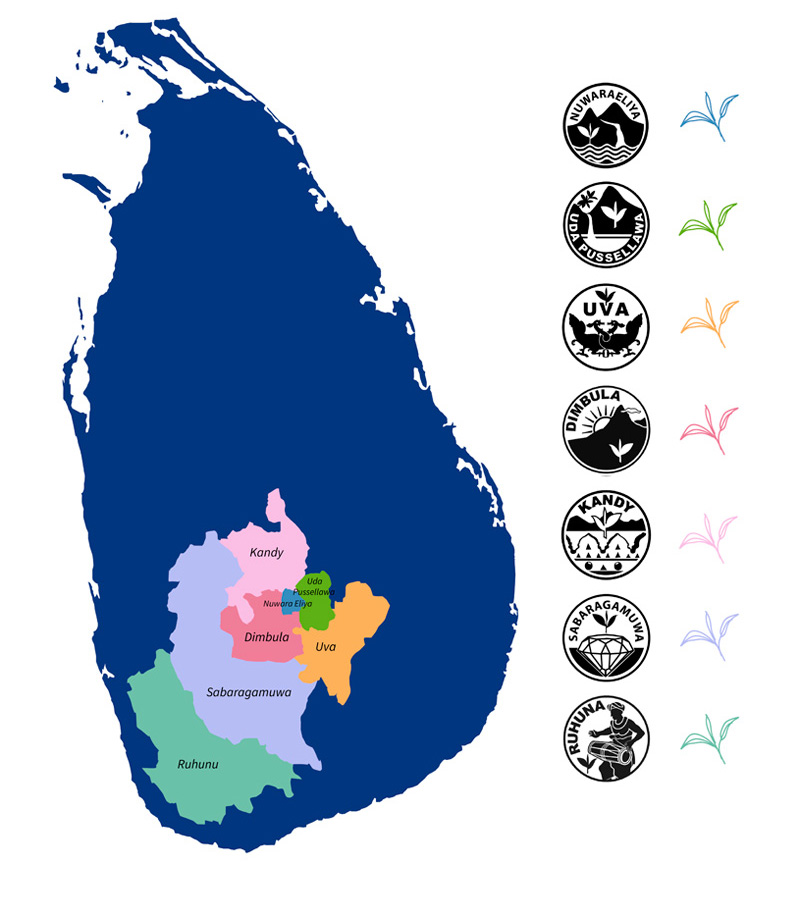
The brew in your cup has a story to tell. It speaks of rolling hills, abundant sunshine, and lush provinces. In Sri Lanka, the central and southern provinces produce most of its tea. Varying elevations and micro-climates influence the distinctive flavour, colour, aroma and seasonality of Ceylon tea.
Low-country (Upto 2000ft above sea level)
The regions of Ruhuna and Sabaragamuwa are known for their long leaf tea. When tea from this region is brewed, you get a cuppa with a burgundy hue and a caramel and malty flavour. This black tea is popular in the Middle East, the CIS countries, and the UK.
Mid-country (2,000ft -4,000ft above sea-level)
Tea from the misty hills of Kandy is known for its full-bodied flavour and a copper tint. It’s a favourite amongst the Aussies and Americans.
High-country (Above 4,000ft from sea-level)
The eastern highlands of Uva, is celebrated world-wide for its intense pungency and refreshing aroma. Unique to Uva are micro-climatic conditions that allow estate owners to experiment with growing new types of tea. There are three other high-altitude provinces in Sri Lanka called Nuwara Eliya, Dimbula, and Uda Pussellawa. If you like aromatic teas with a mellow character, you will love the tea from here.
Ceylon Tea as we now know comes in different varieties, which has flavors and aromas unique to itself. Along with the a variety of teas, there are varieties of grades that Ceylon tea has been separated into. The grading of tea does not affect the flavors and aromas or the quality for that matter, it is a mere indication of the size and appearance of the tea leaf that is manufactured.
Ceylon Tea is basically dived into two categories
1) Whole leaf grades, which has been a consistent form of grading throughout the years. The Orange Pekoe (OP) grades are for the whole leaf traditional black tea.
2) Broken Leaf Grades, which are commonly used among consumers these days. Terminology of Grades
Fannings– These are the leftovers of the manufacturing process, in which high quality tea leaves are produced such as the Orange Pekoe. This low quality tea has experienced a high demand during the last century as drinking tea became a popular habit.
Flowery– this grading consists of larger leaves, that are typically plucked in their second or third flush, and tips are scarcely present. These grades fetch high prices in the international markets, and are expensive to produce.
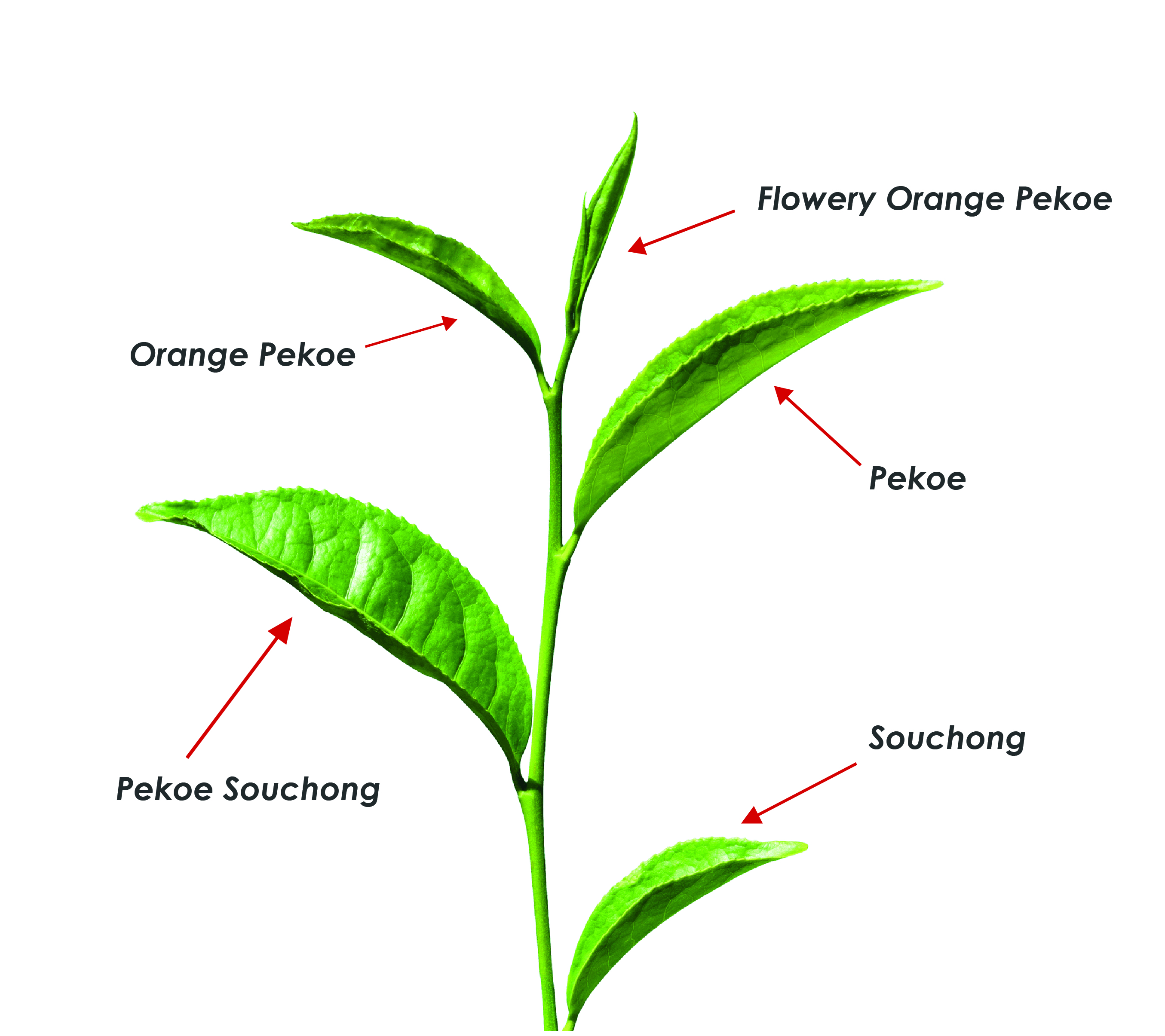
OP (Orange Pekoe) – This is the highest and main grade of tea produced. This comes as a whole leaf which is wiry, long and thin in character. Its flavor when brewed is of a delicate fragrance and tastes exquisitely delicious. The color of the tea comes to a light pale color.
PEKOE – This grade consists of leaves that are short and not so wiry as OP. Twisted and Coarse tea. Once its brewed has a hint of bitterness and a sweet finish to its flavor, and its rich in color.
PEK 1 (Flowery Pekoe) – Similar to Pekoe but smaller in size.
OPA (Orange Pekoe A) – This grade has a long, bold leaf which varies from tightly wound to almost open at times. Long bold leaf tea with air twist consisting of large and slightly open leaf pieces.The color of the liquor is much lighter and has a mild flavor to it.
OP 1 (Orange Pekoe 1) – This grade has a delicate, long, wiry leaf.Long, wiry well or partly twisted tea. It has a light liquor and the a refined taste that adds to its high quality and rich color.
BOP (Broken Orange Pekoe) - This grade is the main in the broken range,is one of the sought after grades.A popular leaf size which helps to bring out a good balance of taste and strength. Well made, neat leaf of medium size without excessive stalk or fiber. There should not be any fine particles (fanning & dust) which are not true-to-grade.The flavor of the tea once brewed is rich and fresh and also has a brighter color to it.
BOP1(Broken Orange Pekoe 1) - This grade has leaves which are wiry and medium in length. They are golden in color with mild and malty flavor to it. Its one of the best tasting teas in the broken range.A well twisted semi-leaf tea generally from the country, with a mild malty taste.
BOPF (Broken Orange Pekoe Fannings) - This is one of the most common grade in Sri Lanka. Particles are smaller than BOP, popular in the higher elevations. Taste stronger than BOP whilst retaining all other characteristics.Its characteristics include a neat, and fairly clear tea leaf which is smaller in size than the BOP. Its bright in color once brewed and has richness to its flavor.
FBOP (Flower Broken Orange Pekoe) - These eaves are more coarse and broken and includes tips, they are smaller and shorter than BOP 1 and has a soft taste to it. Its bright in color and rather flavorsome.
FBOP1 (Flowery Broken Orange Pekoe One)- Long twisted wiry leaf, fairly tippy. Longer than BOP1.
FBOPF (Flowery Broken Pekoe Fannings)– This is one of the best grades in the Fannings range. It is smaller in size similar to that of BOPF, it has a reasonable amount of tips and is bright in color. It has a rich flavor along with a freshness.
FBOPF1 (Flower Broken Orange Pekoe Fannings1)- The leaves of this particular grade are larger in size to that of BOP, and it contains a rather low amount of tips. A typical semi-leaf tippy teas, similar to BOPF but firm leaf consisting little more tips than FBOPF.When brewed it has a sweet flavor to it.
FBOPF SP (Flowery Broken Orange Pekoe Fanning’s Special)- Similar to the FBOPF1 but firm and more black leaf with much better tips, prices are high.
FBOPF EX SP (Flowery Broken Orange Pekoe Fanning’s Extra Special) – Similar to FBOP1 but firm and more black leaf with much better leafy tips, expensive than them.
In addition to the above, there are “Flowery” variants of the main grades. These teas posses a spectacular quality to it. These grades garner higher prices in the international markets and are very costly to produce as they sort the tips by hand.
These are some of the most commonly found grades in Ceylon tea, note however that these grades differ where Green Tea and White Tea is concerned. Each grade has a uniqueness to it self, the flavors and aromas differ in each grade, all this helps you to have a wonderful experience in drinking tea.
D(Dust)- Similar to D1 but will appear slightly brown powder leaves price must be low.
D1(Dust 1)- The smallest of particles smaller than Fanning’s leaves.
CTC Teas (Cut, Tear& Curl)
BPS(Broken Pekoe Special) – Even curl pieces.
BP1(Broken Pekoe 1)– Little smaller then BPS.A larger size leaf with bold round particles giving a full body’s bright tea. Equivalent to size of high grown BOP, but granular.
BPL(Broken Pekoe Leaf)– Even leaf pieces.
PF1(Pekoe Fanning’s 1)– Similar to BP1 but small pieces.A smaller size leaf with strong tasting tea. Equivalent in size to grainy high grown BOPF, but granular.
PD(Pekoe Dust)– The smallest of particles smaller than PF1 leaves.
BOP 1A (Broken Orange Pekoe one A)– Weight Less Large leaves.Flak leaf without stalk and fiber. (Clean tea)
BM (Broken Mix)– Smaller then BOP 1A’s.
PFGS (Pekoe Fanning) – Fanning’s broken leaves, slightly larger than dust.
FNGS– Fanning’s broken leaves, slightly larger than dust.
FNGS 1– Fanning’s broken leaves, slightly larger than FNGS.
PFNGS– Fanning’s broken leaves, slightly larger than dust.
PFNGS 1– Fanning’s broken leaves, slightly larger than PFNGS.
BP (Broken Pekoe)– Broken Stems, choppy, hard leaf tea.
Subscribe to our newsletter to stay informed of news and events at
UNI BROTHERS